

An honest reflection on life after 60—still working, still learning, and still building at 71. No hype, just perspective.

I’m 71 years old—almost 72—and this isn’t where I thought I’d be at this stage of life.
I’m not retired. I tried to retire at age 60 but I wasn’t ready and ended up in bankruptcy. So, I’m still working, still learning, and still figuring things out.
I’m sharing this not as advice and not as a success story, but as an honest reflection for anyone navigating life after 60 and quietly wondering how they ended up here—or what comes next. If that sounds familiar, you’re not alone.
Some links on this site may be affiliate links. This means that if you choose to click and make a purchase, I may earn a small commission at no extra cost to you. I only share resources I genuinely use or believe may be helpful.
Summary (Quick Takeaways)
- Life after 60 rarely follows a straight line
- Being “still building” later in life is more common than people admit
- Progress often happens quietly before it becomes visible
- Discipline and consistency matter more than motivation
- You don’t have to have everything figured out to keep going
Table of Contents
- What Does It Mean to Be Still Building at 71?
- Why Life After 60 Often Requires Recalibration
- Why Progress Feels Invisible Later in Life
- Discipline vs. Motivation After 60
- Why Many People Quit Too Soon
- Where I Am Now
What Does It Mean to Be Still Building at 71?
Being “still building” doesn’t mean starting from nothing. It means continuing—sometimes slower, sometimes wiser, sometimes more honestly than before.
For many people after 60, building looks less like chasing something new and more like reassessing what still matters. It’s about adjusting expectations, redefining success, and staying engaged with life instead of withdrawing from it.
Why Life After 60 Often Requires Recalibration
By this stage of life, most of us have experienced success, disappointment, detours, and responsibilities we never planned for.
Recalibration becomes necessary because:
- Time feels more precious
- Energy is more limited
- Mistakes feel heavier
- We expect ourselves to “know better” by now
Recalibration isn’t failure. It’s adjustment.
Why Progress Feels Invisible Later in Life
One of the most discouraging parts of rebuilding or continuing after 60 is the feeling that nothing is happening.
That’s often because:
- Early progress is internal
- Skills develop before results appear
- Confidence grows quietly
- Understanding deepens before outcomes improve
Just because progress isn’t visible doesn’t mean it isn’t real.
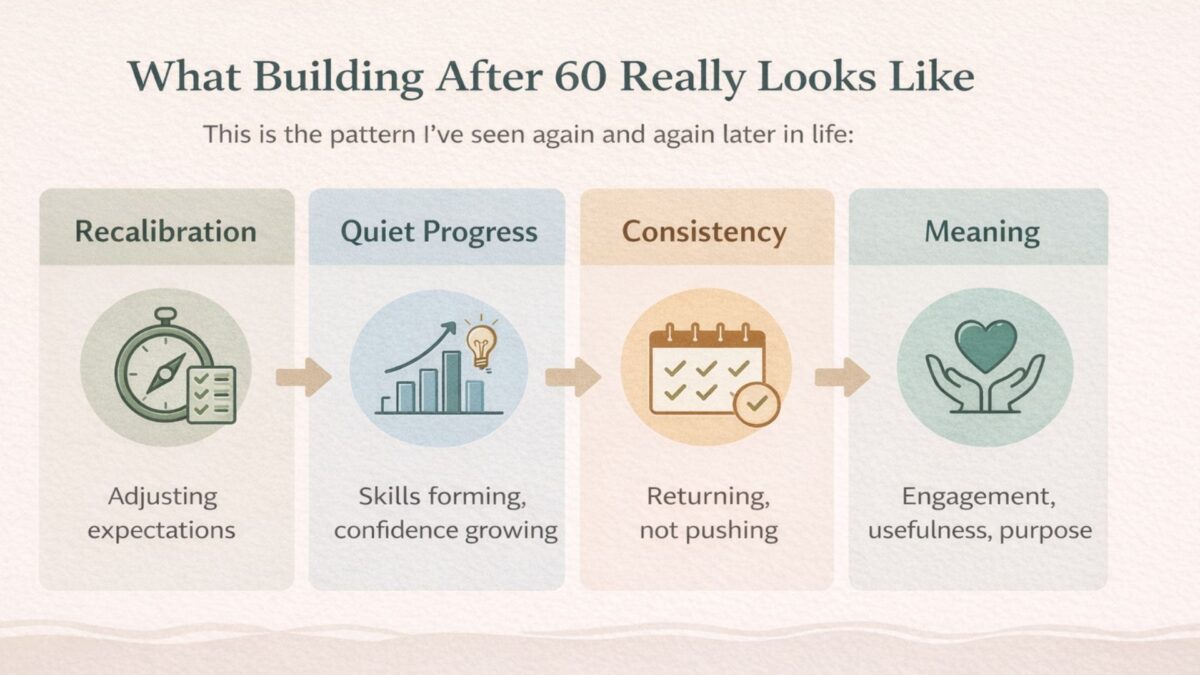
Table: Common Myths vs. Reality After 60
| Myth | Reality |
|---|---|
| I should be finished by now | Growth continues throughout life |
| Motivation is required | Discipline matters more |
| Progress should be obvious | Early progress is often invisible |
| Starting again means failure | Recalibration is normal |
Discipline vs. Motivation After 60
Motivation is unpredictable. Discipline is quieter and more reliable.
Later in life, discipline doesn’t mean pushing harder. It means returning—again and again—to small, steady actions even when motivation fades.
Consistency matters more than intensity, especially when energy and time are limited.
Why Many People Quit Too Soon
Most people don’t quit because they’re incapable. They quit because they expect results too quickly and get discouraged when progress stays quiet.
Later in life, quitting often feels logical—it feels like self-protection. But many people quit just before something meaningful begins to take shape.
Sometimes the most important decision isn’t whether to continue forever, but whether to pause instead of quitting outright.
Where I Am Now
I’m still working.
I’m still learning.
I’m still figuring things out.
Helpful Senior Citizen exists to share honest reflections like this—without hype, without pressure, and without pretending I’ve arrived.
If you’re in a similar place—still trying, still adjusting, still wanting your life to matter—you’re not broken.
You’re human.
And you’re not alone.
Final Thoughts
Life after 60 isn’t about having everything settled. It’s about staying engaged, honest, and willing to keep going—even when the path isn’t clear.
Sometimes, simply continuing is enough.
What do you think? Does this reflection resonate with where you are right now?
Leave comments and questions in the space below. I always reply.
LifeAfter60 #StillBuilding #SeniorLife #AgingWithPurpose
This was such an encouraging and uplifting read! I love how it highlights the idea that life after 60 isn’t a time to slow down. It can be a time to build, grow, and redefine purpose.Your perspective on continuing to pursue goals, stay curious, and keep creating really resonates, especially for anyone who feels like age should limit their dreams.This is a beautiful reminder that we can keep shaping our lives with intention at any stage.
What has been the most surprising or meaningful part of your journey since you started building again later in life?
Hi Jennifer, thanks for your comments. I wish I could say what has been most surprising. There have been so many surprises. I think, first of all, I’m surprised that I don’t feel as old as I thought I would and as surprising, if not more so, I was surprised to meet the love of my life at age 66.
Bob
Thank you for sharing such an honest and inspiring reflection! Even though I am in my 40s, posts like this really make me think seriously about life after retirement, not just financially, but also emotionally and purposefully. I love how you describe life after 60 as still being about building rather than winding down. That’s the mindset I want to carry into my later years: one of curiosity, purpose, and continuous growth, rather than simply “waiting to retire.”
It’s encouraging to see someone in their 70s still learning, creating, and staying engaged with life. It reminds me that the future isn’t something to be feared, but rather something to be shaped. Personally, reading this helps me visualize retirement as a new chapter full of potential, where I can pursue passions, nurture relationships, and still make meaningful contributions, rather than just clocking out and slowing down.
I’m curious, what’s one unexpected joy you’ve discovered in life after 60 that you didn’t anticipate back in your 40s or 50s?
Hi Alysanna, thanks for your comments. In reference to your question/curiosity: I’ll give you two. I planned to be retired by 30, then 60, neither happened. Instead, I found the teaching job I never knew I wanted-teaching ESL, which is what I am still doing, that I found at age 63. The other was/is, finding the love of my life at 66. I didn’t think that would ever happen but it finally did..
Bob